
Every software vendor says it sells AI agents now, which raises a fair question: is anyone actually using them, and are they working?
The answer in 2026 is yes, but not as widely as most headlines suggest. Large companies are moving fastest, smaller and mid-sized organizations are still testing, and a lot of projects are stalling before they deliver anything.
This post pulls together the most reliable 2026 data on AI agents enterprise adoption, the trends behind it, the latest news from Google, and the challenges that slow teams down. We'll also share what we see working with the mid-market and public-sector organizations we support on Google Workspace and Gemini Enterprise.
AI Agents Enterprise Adoption 2026: The Short Answer
An AI agent is software that can plan and carry out a multi-step task with limited human input, such as reading a request, pulling data from several systems, and taking an action. That is different from a chatbot that only answers questions.
Here’s where adoption stands, based on the largest recent surveys:
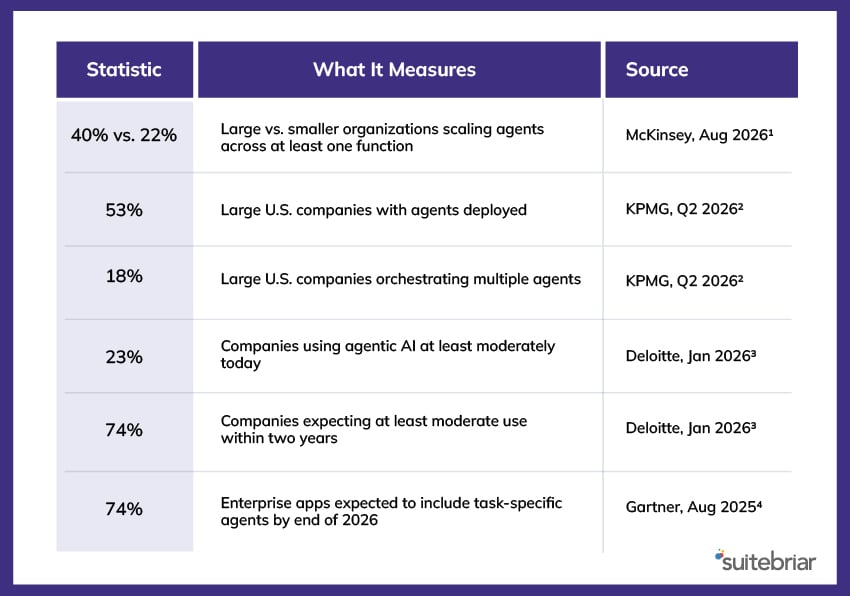
- Scaling is concentrated in big companies. 40% of organizations with $1 billion or more in revenue are scaling AI agents in at least one function, while only 22% of smaller organizations reported scaling.1
- Deployment is common, but scale is not. Over half (53%) of large U.S. companies have deployed agents somewhere.2
- Most use is still light. About one in four companies are using multiple AI agents across workflows.2
- Financial results lag. Only 37% of organizations say AI has had any impact on their EBIT.1
When you take these numbers together, you’ll see a market where interest is high, and business results are still uneven. Most organizations have started experimenting, but fewer have agents doing dependable work at scale – and the gap is widest for companies that don't have large data and engineering teams.
AI Agents Enterprise Adoption Statistics 2026
The numbers vary depending on what each survey counts as "adoption." Some reports count any test, while others count only agents running at scale. Here are the figures we trust most:
Large Companies Are Pulling Ahead
McKinsey's 2026 State of AI survey is the clearest signal, with agent scaling at large companies jumping 13 points in a year. At smaller companies, it didn’t move at all.1
That gap matters for mid-market organizations. Large companies have data teams, platform engineers, and budget to experiment. Most organizations with 50 to 1,000 employees don’t, so they need a narrower starting point and outside help.
Pilots Aren’t the Same as Production
Deloitte found that only 25% of organizations have moved 40% or more of their AI pilots into production.3 Many companies can say they "have agents," but far fewer can say those agents do real work.
AI Agents Enterprise Adoption 2026 News From Google
Google made two major announcements this year that affect any organization on Google Workspace or Google Cloud:
- April 2026, Google Cloud Next: Google launched the Gemini Enterprise Agent Platform, a single place to build, run, and govern agents. It added an updated Agent Designer so business users can build agents with plain language or a visual editor, plus an inbox for tracking what agents are doing.5
- October 2026, Gemini at Work: Google announced a universal Gemini agent that can take on tasks across apps from one Gemini Enterprise interface. It is currently in private preview.6
These updates make agents far more accessible to people outside IT, since a department lead can now build a simple agent without writing code. At Suitebriar, we recently walked through building an employee onboarding agent in Gemini Enterprise with no code at all.
Easier tools haven't removed the need for planning, though. If an agent doesn't have clear permissions, clean data, and a defined owner, it can create new security and support problems no matter how quickly it was built.
Top AI Agents Enterprise Adoption Trends 2026
We’ve seen three trends show up over and over again this year:
Agents Are Scaling in IT First
McKinsey reports that agent scaling is most common in IT (12%), knowledge management (11%), and software engineering (10%).1 These are areas with clear processes, digital data, and teams that are comfortable with new tools, which makes them practical places to prove value before expanding to other departments.
Connected Workflows Are Gaining Ground
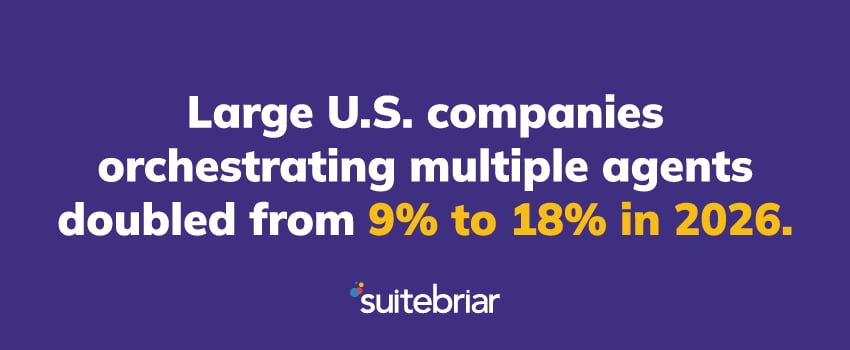
KPMG found that the share of large U.S. companies orchestrating multiple agents has doubled from 9% to 18%.2 Instead of one agent that summarizes email, companies are linking agents that hand work to each other across a full process.
Agents Are Moving Into Familiar Tools
Teams are less interested in a separate AI app and more interested in agents inside of the email, documents, and chat tools they use all day. For Google customers, that means agents built on Workspace data through Gemini Enterprise, so employees don't have to learn a new platform before they see results.
AI Agents Enterprise Adoption Challenges 2026
If adoption is growing, why do so many projects stall? Gartner predicts that over 40% of agentic AI projects will get canceled by the end of 2027.7 These are the most common reasons:
Unclear Business Value
Gartner names escalating costs and unclear value as top causes of cancellation.7 Many projects start with the technology instead of a specific problem.
Weak Governance
Only 21% of organizations told Deloitte they have mature governance for agentic AI.8 Agents that can take actions need rules for what they can access and who approves their work.
Data That Isn't Ready
Agents are only as good as the data they can reach. KPMG's recent industry survey lists data readiness and access as the top barrier to deploying agents.9
Agent Washing
Gartner estimates that only around 130 of the thousands of vendors selling agentic AI offer real agent capabilities.7 Many products are rebranded chatbots or automation tools.
Low Day-to-Day Use
Buying licenses is not the same as adoption. If people aren’t trained and shown how agents fit their work, usage drops off quickly.
How To Start With AI Agents in 2026
The organizations seeing results tend to follow the same pattern. Here’s the approach we recommend:
- Pick one workflow. Choose a repetitive, high-volume task with a clear owner, such as employee onboarding, IT ticket triage, or proposal drafts. Not sure which workflow to start with? We built our AI use case workshop to help teams choose and rank these.
- Fix access before you build. Agents will surface anything a user can reach, so make sure to review sharing settings, permissions, and who can see what in Google Workspace. A Google Workspace security audit is a helpful first step here.
- Use what you already own. Many organizations already pay for Gemini in Google Workspace, and getting teams to use it well is often a faster win than buying a new platform. See our Gemini for Google Workspace adoption and deployment services.
- Train people, not just admins. Short, role-based Google Workspace training helps employees understand what agents can and cannot do.
- Measure one number. Track hours saved, tickets resolved, or turnaround time for the workflow you chose. If the number doesn’t move in 60 to 90 days, adjust or stop.
This approach helps keep your first project small enough to finish and specific enough to measure. Once one agent is delivering results, it'll be easier to make the case for the next one and to expand into connected workflows with confidence.
Ready To Get Started With AI Agents?
The 2026 data makes one thing very clear: the organizations getting value from AI agents are the ones that start with a defined problem and the groundwork to support it. Large enterprises have a head start, mostly because they have more people and budget to absorb experiments that don't pan out.
That's good news for mid-market and public-sector teams, because you don't need to move first. You need to move carefully – one workflow, clean access, trained users, and a clear measure of success.
If you’re on Google Workspace and want to know where AI agents could help your team, the Suitebriar team can help you find a realistic starting point. Talk to one of our Google experts today.
Sources:
- https://www.mckinsey.com/~/media/mckinsey/business%20functions/quantumblack/our%20insights/the%20state%20of%20ai/the-state-of-ai-in-2026-on-the-road-to-roi.pdf
- https://kpmg.com/us/en/media/news/q2-ai-pulse-2026.html
- https://www.deloitte.com/global/en/what-we-do/capabilities/ai/research/state-of-ai-in-enterprise.html
- https://www.gartner.com/en/newsroom/press-releases/2025-08-26-gartner-predicts-40-percent-of-enterprise-apps-will-feature-task-specific-ai-agents-by-2026-up-from-less-than-5-percent-in-2025
- https://cloud.google.com/blog/topics/google-cloud-next/welcome-to-google-cloud-next26
- https://letsdatascience.com/news/google-launches-unified-gemini-enterprise-agent-3927f884
- https://www.gartner.com/en/newsroom/press-releases/2025-06-25-gartner-predicts-over-40-percent-of-agentic-ai-projects-will-be-canceled-by-end-of-2027
- https://www.grcreport.com/post/deloitte-survey-finds-enterprises-charging-ahead-with-ai-agents-while-governance-struggles-to-keep-up
- https://kpmg.com/kpmg-us/content/dam/kpmg/pdf/2026/ampe-aipulsesurvey-q3.pdf