
If you've searched for Vertex AI lately, you may have noticed something confusing: Google doesn't call it Vertex AI anymore. In April 2026, Google renamed it the Gemini Enterprise Agent Platform and made it the home for building AI agents on Google Cloud.1
The platform didn't go away. It grew – and it's now at the center of how many organizations use AI on Google Cloud, with nearly 75% of Google Cloud customers now using its AI products.2 In this guide, we’ll explain what Vertex AI is, what it's called now, and why so many businesses build their AI on it.
What Is Vertex AI?
Vertex AI is Google Cloud's platform for building, deploying, and managing AI. Google made it generally available in May 2021 as a single place for machine learning work that used to be spread across separate tools.3
In plain terms, it's where a company's technical team goes to:
- Pick an AI model, such as Gemini, or train their own
- Connect that model to company data
- Build apps and AI agents on top of it
- Run those apps securely and keep an eye on how they perform
On April 22, 2026, Google announced the Gemini Enterprise Agent Platform and described it as the evolution of Vertex AI. It includes the model and agent-building tools Vertex AI customers already used, plus new features for connecting, running, and securing agents. Google also said all Vertex AI services and future updates will now be delivered only through the Agent Platform.1
Most people still search for "Vertex AI," so you'll see both names for a while.
What Is Vertex AI Studio?
Vertex AI Studio, now called Agent Studio, is the visual workspace for testing prompts and building AI agents.3 It's low-code, so teams can try ideas quickly without writing much code. When a project needs more control, developers can move the work into Google's Agent Development Kit (ADK) and keep building in code.
A few common uses include:
- Testing how different models answer the same prompt
- Building a first version of an agent
- Adjusting instructions until the output is reliable
- Showing business stakeholders a working prototype before committing development time
Agent Studio is most useful at the start of a project, when the goal is to learn what works before investing in a full build. It gives technical and business teams a shared place to test ideas, which helps everyone agree on what the finished agent should do.
What Is Vertex AI Search?
Vertex AI Search, now called Agent Search, lets organizations build Google-quality search over their own content.³ Instead of searching the public web, it searches your documents, websites, and data, and it can give direct answers based on what it finds.
Businesses use it for things like:
- A support site where customers get answers from product manuals
- An internal search tool that finds policies and procedures
- A retrieval layer that gives AI agents accurate company information to work from
That last use is becoming more important as companies build more agents. An agent can only give accurate answers if it can find the right information, and Agent Search gives it a reliable way to pull from your own approved content instead of guessing.
What Do Companies Build With Vertex AI?
Common projects include:
- Customer support agents
- Document processing
- Internal knowledge search
- Sales research
- Financial analysis
Google reports that Payhawk cut expense submission time by more than 50% using the platform's memory features.1
What Is Google Vertex AI Made Of?
The platform has several main parts. Many of them were renamed in 2026, so here's a quick reference:
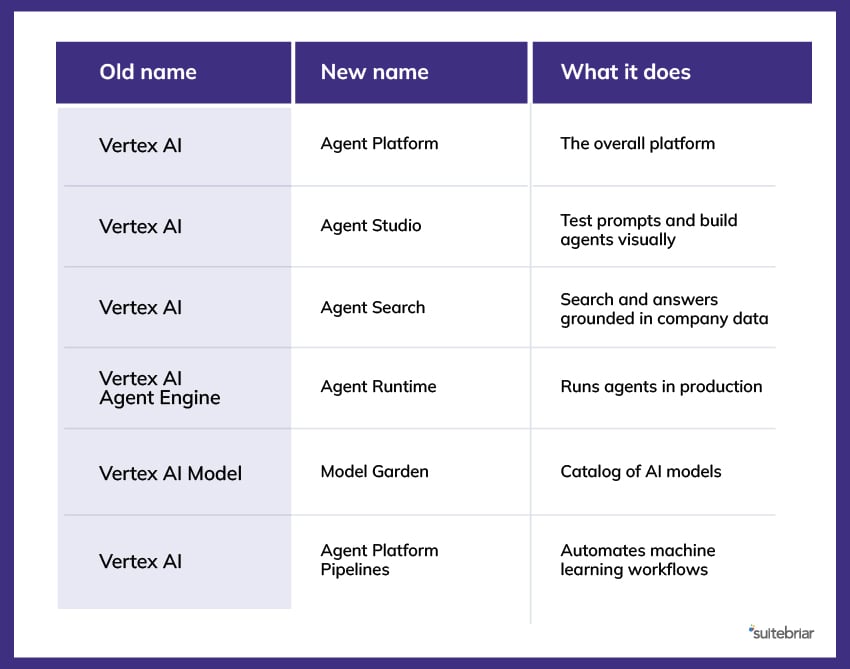 Model Garden
 is a catalog of more than 200 AI models. It includes Google's Gemini models, open models like Gemma, and third-party models like Anthropic's Claude. Teams can compare models and pick the right one for each job instead of being locked into one option.
Tools for Running Agents
The recent update added tools to run agents at scale and keep them under control, including long-term memory, a central registry of approved agents, and a unique identity for every agent so IT can track what each one does.
What Is GCP Vertex AI vs. Gemini Enterprise?
This is where many people get confused. "Gemini Enterprise" is now Google's umbrella name for its business AI products, and it has two main pieces:1
- The Gemini Enterprise app is what employees use. It's where people chat with Gemini, search company information, and use agents in their daily work.
- The Gemini Enterprise Agent Platform (formerly GCP Vertex AI) is what developers and IT teams use to build, run, and govern those agents and AI apps on Google Cloud.
Essentially, the Agent Platform is the workshop, and the Gemini Enterprise app is where employees use what gets built there. Suitebriar’s Gemini Enterprise team works on both sides, from setting up the platform to helping employees adopt the agents that run on it.
What Is Google Cloud Vertex AI Used For?
Businesses choose Google Cloud's AI platform for a few practical reasons:
Model Choices
With more than 200 models available,1 teams can use Gemini for one task and a different model for another, all under one set of security and billing controls.
Connected Data
Agents can connect to BigQuery and other Google Cloud services, so companies that already store their data there don't have to move it somewhere else.
Built-In Governance
Agent identity, an approved-agent registry, and security monitoring make it easier to prove who did what, which matters for regulated industries.
Single Path to Production
The same platform handles early testing in Agent Studio, deployment, and ongoing monitoring. That means fewer handoffs between tools.
 What Changed for Existing Vertex AI Users?
If your team already uses Vertex AI, here's what you need to know:
- Your existing work keeps running. Features moved under new names, and Google says bookmarked links redirect automatically.4
- New features ship only on the Agent Platform. Future updates won't arrive under the Vertex AI name.1
- Documentation and training materials need updating. Internal guides that reference "Vertex AI Studio" or "Vertex AI Search" should use the new names so people can find the right tools.
The rename is mostly a change in labels for existing users, but it's a good moment to review your current AI projects.
How To Get Started With Google's AI Platform
You don't need a data science team to start. Here's a practical path:
Pick One Problem
Choose a task with clear value, such as answering support questions or summarizing contracts. Not sure what the best AI use case is for your team? Suitebriar’s AI Activation Workshop can help you choose the right option.
Check Your Data
AI is only as good as the information it can reach, so make sure the data you’re going to feed it is accessible, clean, and permissioned correctly.
Prototype in Agent Studio
Build a simple version of your agent and test it with the people who'll actually use it. Their feedback will show you what needs to change before you invest in a full rollout.
Plan for Production
Decide who owns the agent, how it will be monitored, and what it's allowed to access.
Get Help Where You Need It
At Suitebriar, our Google Cloud consulting team can set up the foundation – and we also build custom AI agents if your team would rather not build in-house.
Build on Google's AI Platform With the Right Partner
Vertex AI is now the Gemini Enterprise Agent Platform, but the core idea is the same: one place to choose models, connect them to your data, and build AI that does real work. What changed is the focus on agents, with new tools to run them reliably and keep them governed.
If you're deciding whether to build on Google Cloud, moving existing Vertex AI projects forward, or planning your first AI agent, we can help you make a plan that fits your team. Talk to a Google expert at Suitebriar.
Sources:
- https://cloud.google.com/blog/products/ai-machine-learning/introducing-gemini-enterprise-agent-platform
- https://www.channelinsider.com/infrastructure/cloud-and-hybrid/google-cloud-agentic-announcements-next-2026
- https://www.zdnet.com/article/google-launches-vertex-ai-a-platform-to-connect-ml-tools
- https://docs.cloud.google.com/gemini-enterprise-agent-platform/release-notes?authuser=1